
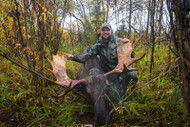
Four Bulls and a Wild Ride
Posted by Andrew Jacobsen on Oct 28th 2026
For those who have hunted in Alaska, and especially those who have experienced a DIY hunt, know that the actual hunt is not the most important aspect of the trip. The hunt begins months before you step into the field. Logistics, equipment, transportation, food, weather, and most importantly, the people you choose to go with all have to come together. Even with months of preparation, there are still factors that are completely outside your control.
I was fortunate enough to get an invitation to join this hunt with much of the planning already in place. Looking back now, I realize that the preparation might have been the most important part. Over the course of the hunt, I gained a few more gray hairs, probably a few new wrinkles, and a much greater appreciation for how quickly an Alaskan hunt can change, with numerous lessons learned.
The trip started smoothly. Flights were on time, weather was good, and everything seemed to be falling into place. That changed immediately when we arrived. Equipment had been scattered and damaged during shipment, and we had to make quick repairs. A critical piece of equipment, my tipi hot tent, had been lost in transit. In most situations, losing a tent would be an inconvenience. In our situation, it was a safety concern. Freezing temperatures were in the forecast, with a winter storm predicted, and we were heading into a remote area where replacing a piece of gear wasn't as simple as making a trip to town.
Due to the remoteness, we couldn't simply make a call or send a text to solve the problem. Fortunately, we met a fellow Alaskan who was willing to lend his own tent to a group of strangers. We spent the remainder of our time getting equipment organized and preparing while the weather was still good. Once all four of us were together, we loaded up and headed out.
The first part of the trip immediately reminded us why we had spent so much time preparing. Within an hour of getting underway, we spotted our first bulls. We continued upriver, working our way toward our camp, with plenty of optimism. The next morning brought three separate encounters before noon, but without success. Zach and I were riding high. The sky was blue, the country was beautiful, and there were moose seemingly everywhere around us. At that point, it was easy to believe the rest of the hunt would be just as cooperative.
Then the boat gave me its first scare.
On the way to camp after another stalk, the motor suddenly lost forward propulsion. The engine was running, but the boat wasn't going anywhere. We scrambled to get the oars out and worked our way into shallow water. Commands were flying toward Zach as he tried to keep the boat secure while I worked through the problem without making any progress. With a lot of outside help, we eventually got moving again, but the problem wasn't completely resolved. We no longer had all of our drive options. On a boat-based hunt in remote Alaska, a problem with the boat isn't simply a mechanical inconvenience. The boat is your transportation, your connection between camp and the country you're hunting, and, in many situations, your way home. We continued on to camp, knowing that we would have to work around the issue for the remainder of the hunt.
After getting camp established and taking care of the less glamorous work, we headed out for our first real evening hunt. We hadn't gone far when we spotted another bull crossing the river. We tried calling him in but couldn't get the wind right, so we moved upriver to get into a better position. We worked around a hill and glassed the area where we expected the bull to emerge.
Within minutes, we spotted a bull appear through an opening. I started my stalk. As I worked toward him through the marsh in my socks, I spotted not one bull but three bulls.
Two were bulls I would have been ecstatic to put my tag on. My target bull was 87 yards away but separated by a deep slough and no cover. Another tremendous bull was bedded down farther into the timber, seemingly unconcerned with everything happening around him. About 150 yards off to my left was a third bull, significantly smaller than the other two, grunting and raking, trying to convince the larger bulls to come out.
Without the ability to close the distance on the bigger bulls and with a non-ideal wind, I worked back to Zach, who had been raking and grunting from the cover of the timber.
Eventually, Zach and I decided to switch things up and make a play on the smaller bull on our side of the slough. Zach slipped down to his socks while I stayed behind him. We worked the terrain and the wind, closing the distance to the bull's last known location.
I began raking and thrashing the willows while Zach crept ahead. Within seconds, the bull responded and started coming directly toward him. Everything happened quickly at close range.
Zach drew, and the shot hit the bull hard quartering away, but the arrow was deflected low. We watched his escape and immediately started tracking the trail. Initially, the signs looked encouraging. Pools of blood and spray on the leaves could be seen quickly, but the farther we went, the lighter it became. Then came the masses of fatty tissue hanging off the bushes and downed timber. We had every reason to believe the wound was fatal, but we didn't know how long it would take.
We backed out briefly to get our gear and talked through the situation. With several days of rain in the forecast, we decided that if the bull was still alive, we needed to keep pushing rather than risk losing the trail later. Still in our socks, we went back after him.
The blood continued to diminish until we were scanning leaves and brush for individual drops. Eventually, we jumped the bull and could see the extent of the wound. It was going to be fatal. He pushed toward the river and crossed. By the time he reached the opposite bank, he had used nearly all of his strength.
The recovery itself was almost anticlimactic. After all the uncertainty of the stalk and tracking job, the meat was only about ten yards from the boat.
One of four tags filled on the first day of hunting.
That night, the four of us replayed the encounter, talked about the days ahead, and began planning the next moves. Spirits were still high. We had a bull in camp, we knew there were more animals around us, and despite the early boat issue, the hunt was unfolding quickly.
The next morning started with clear skies. We throttled up the river, stopped at several glassing points, and found bulls scattered throughout the country. We ate an unreasonable amount of blueberries along the way and eventually idled downriver again. One trophy-class bull crossed in front of us, and we tried to make something happen with a combination of calling techniques, but he wasn't interested.
We passed camp and decided to check another back slough, but as I throttled down, the motor died. This time, it wouldn't turn over. Absolutely no response.
We quickly beached the boat, with Zach scrambling to hold it while we tied up. After a few choice words, several satellite messages, and a series of unsuccessful attempts at diagnosis, I started working through everything I could. I checked the battery, pulled fuses and wires, checked the spark plugs and oil, and worked through the motor piece by piece. Nothing immediately revealed itself with my limited mechanical knowledge.
Eventually, I put everything back together, crossed my fingers, and turned the key.
It started.
The relief of hearing the motor run was followed almost immediately by the realization of what this could mean for the rest of the hunt. More satellite messages went out, and a possible diagnosis eventually emerged. Bypassing the shifting components on the tiller from the first issue to put the jet into drive, I had inadvertently allowed the motor to run in neutral for hours, burning up a fuse and the thermal components. By pure luck, it restarted.
The motor was running again, but now every trip away from camp had to be planned upriver and with mechanical issues as a consideration. In three days, my confidence in the hunt had roller-coastered from one end of the spectrum to the other.
Then the weather changed.
The next morning brought a downpour. We followed the same routine anyway. We spent hours boating, glassing, and sitting through steady rain. Water worked its way through the face holes of our rain gear down our waders, and into our clothes until we were soaked through to our knees. We returned to camp early, crawled into the tent for a few hours, and tried to get some warmth back into ourselves before heading out again.
The motor problems were still sitting in the back of my mind, but there wasn't much point in dwelling on them. We were there to hunt.
We went out again with no luck or action. Late that afternoon, we returned to camp and saw Josh carrying the first hindquarter of a bull.
Micah had filled his tag.
He had taken the bull only a few hundred yards from camp shortly after Zach and I had left that morning. The recovery became a quick team effort. We made a couple of short pack-outs, moved the meat, and got the bull taken care of. It might have been the most memorable pack-out of the trip, with some good laughs and blood flow back into the legs.
Suddenly, we were halfway done.
The mood around camp changed immediately. After the day of heavy rain, missed opportunities, and mechanical problems, seeing another animal hanging in camp gave everyone a boost. There was a lot of excitement for the next day, even though all four of us were soaked and there was no real way to get completely dry.
We headed back out the next morning for more of the same, still wet from the day before. We glassed and floated until we decided to work into a meadow to see if we could get a hidden bull interested.
Eventually, a small bull with two brow tines responded. He came in to around 200 yards and presented a legitimate opportunity.
But my mindset had changed since the beginning of the trip.
At first, my goal had simply been to come home with almost any bull using my bow, and a bull I would be excited to hang in my house. After several encounters with large bulls, I had started holding myself to a different standard. I was looking for a large trophy bull.
I was too encompassed by the measured size of the bull and not the hunt as a whole.
There were bulls around us. We had seen them repeatedly. But every time you pass an opportunity, you accept the possibility that another one may not come. The days were passing, the weather was wet, the boat still had its issues, and we had already watched several good opportunities disappear.
Josh was experiencing the same cycle from a different perspective. He had an unforgettable stalk on a quality bull that ultimately didn't work out. Around camp, the stories of missed opportunities and sightings of bulls became just as much a part of the hunt as the successful ones.
By the time we returned that evening, the biggest victory was getting a fire started.
The four of us huddled around it like we had never seen fire before, staring at the small flame and enjoying every bit of heat it produced. It was a simple thing, but after spending days wet, it felt like a luxury. That night, climbing into my sleeping bag, I was wet but not soaked.
The next morning, we leapfrogged with Josh and Micah, moving between glassing points and working different stretches of the river. Early in the afternoon, while idling along, I spotted a bull tucked into a back slough. I grabbed my rifle and headed off while Zach stayed behind to secure the boat.
This encounter was a good measure of how my mindset had changed. Earlier in the trip, the bow had been my first choice. This time, it stayed in the boat.
The stalk was quick, and the excitement was even quicker. As I worked through the brush, Zach was behind me grunting and raking. We got a response almost immediately. For a few seconds, it looked like the situation might come together.
Then the bull caught something he didn't like.
All I could see was the horizontal line of his back as he turned away through the thick brush. He was less than 25 yards away, but the only thing I could hear was the sound of his grunts getting farther away.
Just like that, the opportunity was gone.
Again we worked back to glass and call into a meadow. The dead time is one of the hardest parts of hunting. You sit staring at the same tree line and replay the events of the hunt. You might have just had an encounter, but it feels like it has been days since a sighting. You wonder about the bulls you passed, the ones that got away, and how many opportunities remain In the back of my mind was always the boat and our exit back to civilization. Every plan for the following day required another mental calculation about distance, fuel, and whether the motor would cooperate.
We eventually gave up on the meadow and spent the rest of the day drifting several miles of river.
The next morning started differently.
The night before, I had taken inventory of our fuel, cleared the motor's telltale lines of the accumulation of grit, and checked everything I could. I knew we needed the boat to carry us through another long day, and I wanted to start with as few unanswered questions as possible. I spent some time lying in my sleeping bag thinking through the next morning. I looked at the map, considering different areas and trying to decide where we should spend our time.
Then, at daylight, right as the light rain stopped tapping the top of the tent, I got up and started loading the boat.
I was hunched over inside the boat when Micah's face suddenly appeared inches from mine.
"There's a bull behind camp."
I didn't immediately register what he was saying. I hurried back to my tent, grabbed my rifle, and put my crosshairs on the bull standing only about 35 yards behind camp.
Almost immediately, I realized he was well within bow range.
I whisper-yelled at Micah to grab Josh's bow. Josh was still curled up in his tent in nothing but his base layers.
Within seconds, the bow was thrust into the tent, and Josh was at full draw, waiting for the bull to give him the right angle. The bull leisurely crossed the creek behind camp, completely unconcerned with the commotion around him. He stopped, shook the water off, and continued.
Josh released.
From where I stood, the arrow seemed to travel in slow motion. Perfect hit.
Another tag filled, and only mine remained.
The celebration lasted only a few moments. Josh and Micah immediately went to work tracking, processing, and packing out the bull. Zach and I headed back out.
We passed several cows and smaller bulls tucked into the willows as we worked upriver. Low clouds and mist hung over the country when we finally spotted a bull tucked into the vegetation. He was on his feet and preparing to cross a shallow braid in the river. Zach immediately recognized what we were looking at.
"That's a shooter."
"Shoot that bull."
"Anchor him."
While I maneuvered the boat through the shallow channel below the bull, Zach looped my release and got an arrow nocked. We reached the riverbank just as the bull stepped out of the vegetation.
"Eighty-five yards," Zach called out.
The bull continued to quarter away from us. We tried raking and grunting, but he wasn't interested.
Then he began to swim.
The opportunity with the bow was disappearing. Zach kept encouraging me to take the bull with his continued one-liners.
I reached for the rifle, and just as the bull climbed the steep bank on the other side, the first shot broke. He immediately turned around and jumped back into the water.
For a moment, the entire situation looked like it could become complicated. The worst possibility was watching him expire somewhere in the deep part of the channel, where recovering him would be extremely difficult.
I kept whispering, "Don't you die in the water. Keep going."
By the time he reached the shallow water, he was hunched backed and nearly frozen on the gravel, but on his feet. Zach's chants had not stopped since first spotting the bull.
Another shot rang out.
The bull took the full force of the shot and then slowly lurched toward the thick brush.
We pushed off immediately, working our way around the small island created by the braided river in an attempt to get ahead of him in case he attempted an escape. We tied up, moved into position, and waited. We scanned the riverbank and the taller vegetation for movement.
Stepping off the boat to stalk into this last known location, we heard brush moving and deep grunts. Not wanting a rodeo, we backed out to the boat. The brush continued thrashing back and forth, but all we could see were the tops of the vegetation moving from side to side.
Then it stopped.
Eventually, we pushed off and worked slowly along the bank, pulling the boat through the shallows. Through a narrow opening in the brush, we finally saw him.
Belly down.
Face down and still.
The fourth and final tag was filled.
The feeling was a combination of excitement and relief. I had accomplished what I had come there to do, but the hunt wasn't finished. We still had a mature bull to break down, meat to get back to camp.
We took our time before starting the work. Initially, the cuts were clean, and everything moved efficiently. But as the work continued, the fatigue from the previous week began to show. Breaking down an animal of that size takes strength, some skill, but a lot of patience.
Four hunters.
Four bulls.
Four filled tags.
For the first time all week, there was nothing left to hunt.
We hung the meat and finally sat around the fire discussing what came next.
That's when the next round of chaos began.
Because we had filled all four tags almost a week earlier than expected, our departure plans suddenly had to change. Satellite messages started going back and forth. Flights had to be moved. Transportation had to be rearranged. Plans were made, changed, and sometimes changed again before the previous plan had even been completed.
Eventually, we decided the best option was to cut the distance the following day, float downriver, make camp, and give everyone back home time to straighten out the logistics.
The motor carried us through that next day, but by then every sound it made had my attention. We had learned during the hunt that even a functioning motor could be one small problem away from changing the entire plan.
The morning of departure was a whirlwind. We broke camp before first light and started moving. The rest of the day became a blur of racing up and down the river with meat, gear, and trophies. The scene at the boat launch was comical to watch, with loading, unloading, and shuffling of gear.
Although all of the departure plans were not ideal, the four of us were headed in separate directions toward home, with some time to wind down.
It wasn't until I was home, unpacked, and had a chance to take a breath that I could really reflect on the entire experience.
Not just the hunting, but the whole process.
I learned a lot about preparation. I learned how quickly unexpected problems can change the way you approach a remote hunt. I learned I need to become a more educated and skillful backcountry adventurer.
But more than anything, I learned the importance of the people you hunt with. There is a phrase in hunting circles that it is harder to find a good hunting buddy than it is to find a wife. There might be some truth to it.
Zach's ability to keep pushing and go through each opportunity for my bull even after tagging out early in the hunt was a constant. He has had the ability to stay level-headed through the chaos, even when I was barking out commands and bossing him around throughout the trip without losing his patience. Micah's ability to recognize an opportunity and put a bull down near camp changed the dynamic of the entire group. His calm personality brought a different balance to the group. He never needed to be the loudest person in camp or say much to make an impact, but when an opportunity presented itself, he was ready. Josh's perfectly executed opportunity behind camp gave us another tag, and his optimistic outlook shined when we needed it. Each person's contribution to the hunt started long before we ever stepped into the field. And throughout the hunt, each of us brought different skills, personalities, and ways of processing problems to the group. The hunt would have been a very different experience without any one of them.
After every hunt, I try to reflect on more than the animal. I go back through the notes I've made on my phone and think about the gear I would change, the skills I need to improve, and the things I could have prepared for better.
This hunt gave me plenty to document.
It also reminded me that I'm probably not cut out to be a frontiersman from a few decades ago, and certainly not a few centuries ago. Without modern equipment, satellite communication, engines, and the people on the other end helping coordinate everything, I might still be sitting beside a broken motor somewhere in the Alaska wilderness.
But that's also what makes these hunts so rewarding and puts a smile on my face when telling the story of our adventure.
You can prepare for months. You can build a plan, check your equipment, study the country, and think through every possibility. Then you step into the field, and you are only as good as your preparation, skills acquired, and ability to adapt.
Looking back, that's what I'll remember most about this hunt.
Not one particular problem, one particular bull, or even the moment the fourth tag was filled.
I'll remember the entire progression of the hunt. From the four of us moving through the country, solving problems as they came, deep conversations around a fire after being soaked for days, watching opportunities disappear, finding new ones, and eventually sitting around camp with four filled tags.
You prepare as well as you can, surround yourself with good people, and accept that once you leave, the hunt belongs to nature.
That's Alaska.
When people ask me how it went, I tell them I got my Alaska experience.
Would I do it again?
Absolutely, and I'll be waiting for the next adventure whenever these guys are ready.
Discount code: jacobsen15